Leave Your Message
0%

In the ever-evolving world of life sciences, picking the right Molecular Biology Reagentsreally matters if you want accurate results. I mean, according to a rEport by MarketsandMarkets, the global market for these reagents is on track to hit around $25.3 billion by 2025 — that just shows how crucial they are for research and diagnostics. Experts keep stressing that going for high-quality reagents can seriously make or break your experiments. And honestly, it’s often what pushes progress forward in molecular biology.

Dr. Sarah Johnson, a top expert in molecular tech at BioTech Innovations, once said, "The quality of Molecular Biology Reagents can make or break your experiment." That really hits home, right? It just shows how important it is to do your homework before choosing. With so many options out there, labs gotta navigate this maze carefully — you don’t wanna fall into the trap of picking something that doesn’t quite fit your needs. Plus, what you need really depends on your specific experiment and what you’re aiming for.

And here’s the thing — don’t just rely on brand reputation alone. Sure, big-name companies usually have reliability on their side, but there are also emerging companies that might surprise you with innovative solutions. It’s all about finding that balance between performance and what fits your budget. In this pretty competitive and sometimes tricky landscape, understanding what makes these reagents tick is super important if you really want consistent, trustworthy results in your lab work.


How to Choose the Best Molecular Biology Reagents for Your Lab?

Understanding the Fundamentals of Molecular Biology Reagents

How to Choose the Best Molecular Biology Reagents for Your Lab?

Choosing the right molecular biology reagents can significantly impact your experiments. Understanding the functions of each reagent is critical. For example, enzymes like DNA polymerases or restriction endonucleases play different roles in DNA manipulation. A well-curated Molecular Biology Reagents List often includes applications specific to your research.

Recent reports indicate that the global molecular biology reagents market is projected to grow significantly, reflecting increased research activity. This growth emphasizes the importance of high-quality reagents for consistent results. Reliable reagents ensure reproducibility, a key factor for scientific validation. Many labs struggle with inconsistent results due to subpar reagents. This area deserves more attention.

It’s essential to consider sourcing and quality assurance when evaluating reagents. Look for suppliers who provide detailed product information and validation. Peer-reviewed articles often highlight the performance of specific reagents. Research teams frequently share their reagent assessments, providing valuable insights. Adopting a proactive approach to evaluating your molecular biology reagents list may reveal areas for improvement.

Identifying Key Applications and Techniques in Your Research

How to Choose the Best Molecular Biology Reagents for Your Lab?

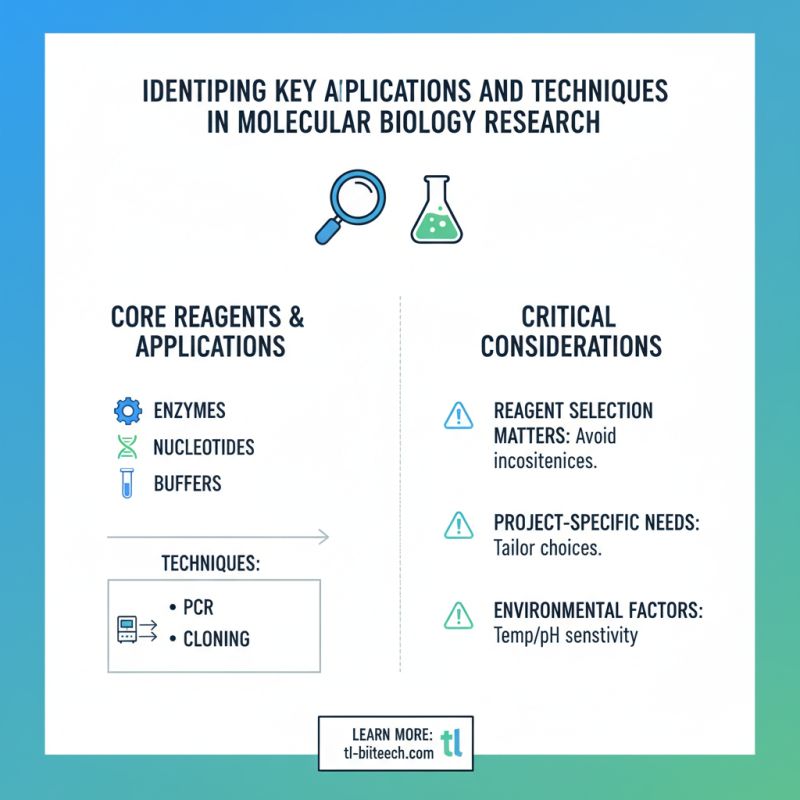
When selecting Molecular Biology Reagents For Academic Labs, researchers must recognize their core applications and techniques. Enzymes, nucleotides, and buffers play essential roles in experiments like PCR and cloning. Failing to choose the right reagent can lead to inconsistencies in results. It's important to consider the specific needs of your project and the conditions under which you will operate. For instance, some enzymes perform poorly at specific temperatures or pH levels.

Understanding the techniques used in your research is also crucial. Techniques like gel electrophoresis require delicate handling of reagents. Using high-quality molecular biology reagents can enhance separation efficiency. However, relying solely on product descriptions without hands-on experience can be misleading. It's vital to conduct preliminary tests to evaluate reagent performance in your specific applications. Experimenting with different options broadens your knowledge, allowing for informed decisions.

Documenting outcomes can provide insights into reagent effectiveness. Not every reagent will yield expected results in every experiment. Take time to reflect on what worked and what did not. This process of trial and error can contribute to a deeper understanding of molecular biology and enhance future studies. Proper selection of molecular biology reagents for academic labs is a balance of experience and informed decision-making.

Evaluating Quality and Purity Standards for Reagents

When selecting molecular biology reagents, quality and purity are pivotal. A recent survey indicates that up to 30% of research inconsistencies stem from poor-quality reagents. Ensuring that reagents meet high purity standards can significantly enhance experimental outcomes. Consider sourcing reagents that are certified by recognized standards, such as ISO or equivalent. This assurance often reflects their reliability in demanding applications.

Tips: Always check the certificate of analysis (CoA) for each batch. It provides insight into the reagent's quality. Be wary of reagents lacking comprehensive documentation, as they may compromise your results.

Frequently, labs utilize reagents with unspecified purity levels, leading to variability in experiments. According to industry data, reagents with a purity of 99% or higher minimize the risk of contamination. This choice not only boosts reproducibility but also saves time and resources.

Tips: Maintain a record of reagent performance. Documenting results helps establish trends that highlight reagents’ reliability. Don’t hesitate to revisit your supplier choices if you notice fluctuations in data quality.

Exploring Different Types of Molecular Biology Reagents

When choosing molecular biology reagents, understanding their types is crucial. These reagents include enzymes, buffers, and nucleotides. Each plays a unique role in experiments. Enzymes, for instance, are essential for DNA amplification and manipulation. Buffers maintain pH levels during reactions, ensuring consistent results. Nucleotides are the building blocks of genetic material and are vital for constructing DNA or RNA sequences.

High-purity molecular biology reagents are critical in European labs. High purity minimizes contamination risks. Contaminated reagents can lead to erroneous results, prompting researchers to repeat experiments. It's vital to consider the source of these reagents. Reliable suppliers often have stringent quality control measures.

While researching, you may notice that not all suppliers provide the same quality. It's worth reflecting on past experiences. Have you encountered issues with reagent fidelity? Such challenges underline the importance of meticulous selection. Quality assessment can be time-consuming but is essential for successful experiments. Prioritizing high-purity molecular biology reagents ensures reliable data and enhances experimental outcomes.

Assessing Cost-Effectiveness and Budget Constraints

When selecting molecular biology reagents, budget constraints should be a top priority. The global market for molecular biology reagents is expected to grow significantly, reaching $18 billion by 2025. Understanding costs associated with reagent selection can help maximize research impact. Utilizing cost-effective reagents can save up to 30% of your budget, allowing funds to be allocated to other critical areas, such as staffing or advanced equipment.

Assessing the cost-effectiveness of reagents involves more than just upfront pricing. For instance, considering the overall yield and performance is essential. A reagent that seems cheaper may lead to higher costs down the line if it offers lower efficiency or requires additional optimization. According to a recent industry report, laboratories that prioritize total cost of ownership often improve research outcomes. It’s crucial to balance quality and price to ensure high-performance results.

Another aspect to consider is the variability in performance. Some reagents might not perform consistently across different experimental conditions. This inconsistency can lead to wasted materials and delayed results. Regularly reviewing vendor specifications against performance outcomes can help mitigate these challenges. In today's competitive environment, careful budgeting can distinguish successful labs from those that struggle to produce significant results.

Finding Reliable Suppliers and Distributors for Reagents

Choosing reliable suppliers for molecular biology reagents is crucial. Suppliers vary in quality, service, and support. Start by evaluating their product range. Some suppliers may have a limited selection. This can hinder your experiment's success. A diverse inventory often indicates depth in sourcing and quality control.

Look for suppliers that provide documentation. Certificates of analysis can confirm the quality of reagents. Contacting previous customers can give insights into their reliability. Ask specific questions about product performance and customer service experiences. Don’t overlook the importance of response time. A prompt reply can indicate their commitment to customer care.

Consider their logistical capabilities. Will they deliver on time? Delays can disrupt your research timeline. Also, research their reputation within the scientific community. Online reviews and professional forums can provide additional context. Some suppliers may offer introductory discounts or special terms for bulk purchases. However, weigh these offers against the overall quality of their products.

How to Choose the Best Molecular Biology Reagents for Your Lab?

Reagent Type Purpose Common Applications Shelf Life Storage Conditions
PCR Reagents Amplification of DNA Genetic testing, cloning 1-2 years -20°C
RNA Isolation Kits Extraction of RNA qRT-PCR, RNA sequencing 1-2 years Room temperature
DNA Ladders Size marker for DNA Gel electrophoresis 1 year -20°C
Enzymes Cutting or modifying DNA Cloning, digestion 1-3 years -20°C
Antibodies Detection of specific Proteins Western blot, immunofluorescence 1 year -20°C

Staying Updated on Emerging Technologies and Innovations in Reagents

In the rapidly evolving field of molecular biology, staying updated on emerging technologies is essential. New reagents continuously hit the market, promising enhanced performance and reliability. Lab professionals must regularly assess these innovations. This requires more than just reading product descriptions. Engaging with recent studies and attending conferences can provide insights into which reagents are currently transforming genetic analysis.

Adopting cutting-edge Molecular Biology Reagents For Genetic Analysis In The Usa often comes with challenges. It's vital to consider compatibility with existing protocols. New does not always mean better. Sometimes, established reagents outperform newcomers. Keeping an open mind while evaluating new options can lead to surprising discoveries. Feedback from peers and published research should heavily inform decisions.

Research communities often highlight the need for transparent data on reagent performance. While some manufacturers publish validation studies, others do not. Reliable data is critical for making informed choices. Some could argue that newer products lack extensive testing. Therefore, weighing the benefits and limitations of unknown reagents is crucial. This reflective approach helps ensure the right choices for your lab’s needs.

FAQS

: What are the essential roles of molecular biology reagents in research?

: Enzymes, nucleotides, and buffers are crucial for experiments like PCR and cloning. They ensure reliable results.

Why is it important to choose high-quality reagents?

High-quality reagents minimize contamination risks, which can lead to erroneous results. Poor choices may necessitate repeating experiments.

What should I do if my reagents don't perform as expected?

Reflect on what worked and what didn’t. Document outcomes and consider troubleshooting different conditions or reagents.

How can I stay updated on new technologies in molecular biology?

Engage with recent studies and attend relevant conferences. This helps in discovering emerging reagents and techniques.

Is it enough to rely on product descriptions for reagent selection?

No, product descriptions can be misleading. Hands-on experience and preliminary tests are crucial for viable selections.

What challenges come with adopting new molecular biology reagents?

New reagents may not always be compatible with existing protocols. Sometimes established reagents perform better than newer options.

How does documentating outcomes help in choosing reagents?

Documenting helps you evaluate reagent effectiveness. This process can deepen your understanding and inform future choices.

Why is the source of reagents important?

Reliable suppliers follow stringent quality control measures, reducing the likelihood of contamination and inaccurate results.

Can I trust all published validation studies of reagents?

Not always. Some manufacturers publish studies, but others do not. Evaluating the reliability of data is vital.

What is the balance needed in reagent selection?

It involves a mix of experience and informed decision-making. Regular assessment and reflection can improve research quality.

Conclusion

Choosing the best Molecular Biology Reagents for your lab is a crucial step that can significantly impact your research outcomes. Understanding the fundamentals of these reagents is essential, as they are integral to a variety of applications and techniques within molecular biology. It is vital to evaluate the quality and purity standards, ensuring that the reagents meet the necessary criteria for reliable results.

Additionally, exploring the different types of Molecular Biology Reagents available can help researchers align their choices with specific experimental needs. Cost-effectiveness and budget constraints play a significant role in selecting reagents, so a thorough assessment is necessary. Finding reliable suppliers and staying updated on emerging technologies and innovations in the field can lead to better reagent selection and utilization, ultimately enhancing the effectiveness and efficiency of research efforts.


Clara

Clara

Clara is a dedicated marketing professional at T&L Biotechnology Co., Ltd., where she leverages her extensive knowledge of cell and gene therapy (CGT) products to drive the company's mission forward. With a strong focus on the research and development of GMP-grade upstream raw materials and......
Previous How to Choose the Right Biopharmaceutical CDMO for Your Needs?