Leave Your Message
0%

In the ever-changing world of biomedical research, you really can't underestimate the importance of Cell Culture Reagents. I mean, Dr. Sarah Jenkins from BioInnovate Labs, who’s pretty well-known in the field, actually points out that, “The right reagents can totally change your research outcomes.” Her words highlight just how crucial these products are when it comes to cell growth, keeping cells alive and healthy, and just making your whole experiment successful.

As scientists and researchers, we’re always trying to push science a bit further, and picking the best Cell Culture Reagents really is a big part of that. The truth is, choosing the right reagents can really be the difference between hitting a home run or just spinning your wheels without getting any meaningful results. Sure, the market is flooded with options, but not all reagents are created equal. You’ve gotta think about quality, where they came from, and whether they fit your specific needs.

Looking back on my own experience, I’ve noticed a pattern — a lot of researchers tend to overlook how important it is to pick good reagents. That can really backfire, leading to wasted time, effort, and resources. Taking a step back to carefully consider your choices here can actually lead to some pretty big breakthroughs. Of course, finding that sweet spot between quality and cost isn’t always easy, but it’s definitely worth the effort.

2026 Top Cell Culture Reagents to Boost Your Research Success?

Overview of Cell Culture Reagents and Their Importance in Research

2026 Top Cell Culture Reagents to Boost Your Research Success?

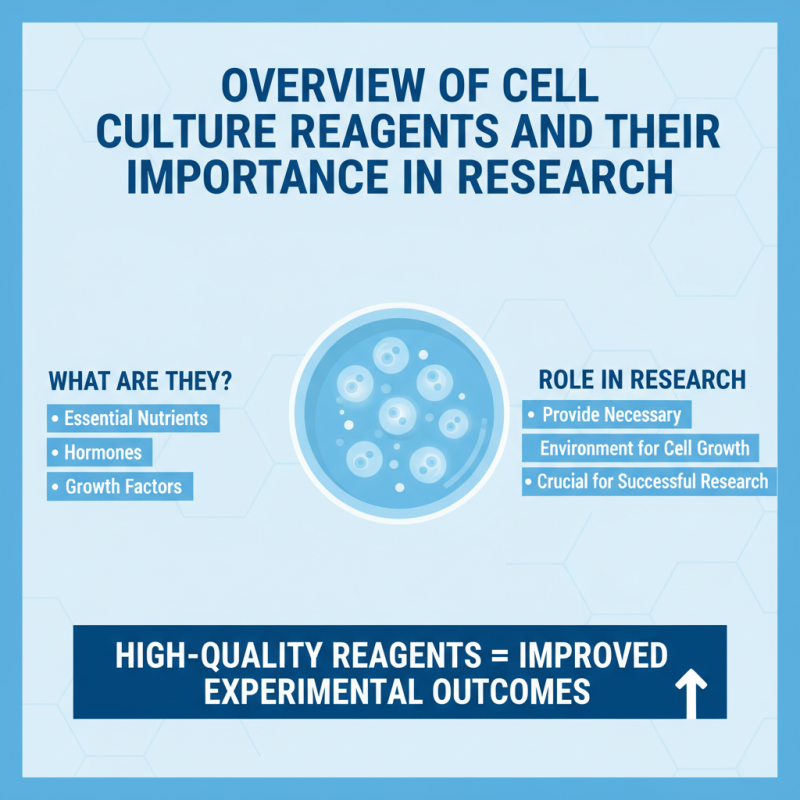
Cell culture reagents are crucial for successful research. They provide the necessary environment for cell growth. This includes essential nutrients, hormones, and growth factors. High-quality reagents can dramatically improve experimental outcomes.

In many cases, researchers face challenges when selecting the right components. Understanding how these reagents interact is often complex. Each component influences cell behavior differently. It's essential to choose the right formulation for your specific cell type. Poor choices can lead to inconsistent results.

Researchers should stay updated on the latest advancements. New reagents often emerge, offering better performance and reliability. However, not all new products are suitable for every application. Careful evaluation based on empirical data is necessary. Balancing cost and effectiveness remains a constant challenge.

Key Categories of Cell Culture Reagents for Scientific Applications

In the realm of scientific research, the choice of cell culture reagents plays a pivotal role. Understanding key categories of these reagents can enhance research success. Essential types include serum, media supplements, and growth factors. According to a recent industry rEport, nearly 70% of researchers prioritize serum-free media to minimize variability in experiments. This trend reflects a shift towards more controlled conditions.

Tips: Always check the compatibility of your selected reagents with your target cell line. This will help avoid unexpected results.

Moreover, the increasing demand for 3D cell cultures has pushed the innovation of specialized reagents. These reagents are crucial for mimicking in vivo environments, thus improving the significance of your findings. Data from a 2022 study indicates that 3D cultures yield 30% more relevant data than traditional methods. Consider incorporating both standard and innovative Cell Culture Media And Reagents for better insights.

Tips: Experiment with different concentrations of growth factors. Small adjustments can significantly impact cell behavior. Understand that not every reagent will work optimally. It's vital to be flexible and observational in your approach.

Top 2026 Trending Cell Culture Media for Enhanced Research Outcomes

In 2026, the landscape of cell culture media is evolving. Researchers seek alternatives to traditional formulations. Enhanced formulations support better cell growth and viability. Innovative strategies focus on specific cell types. These new media solutions strive to replicate in vivo conditions more effectively.

Many labs are exploring serum-free options. These solutions offer greater control over growth factors and hormones. Customizable nutrients allow for tailored support of different cell lines. Researchers sometimes struggle to choose the right medium. This requires a deep understanding of each cell's needs.

Cell Culture Reagents For Cgt are essential for specialized applications. These reagents must work harmoniously with your chosen media. The balance between consistency and flexibility in formulations is crucial. Researchers face the challenge of adapting to new discoveries. Continuous refinement and adjustment are necessary to maximize research outcomes.

2026 Top Cell Culture Reagents to Boost Your Research Success

Reagent Type Trending Medium Key Features Applications
Basal Media DMEM High glucose content, amino acids Cell proliferation, hybridoma growth
Serum Supplements Fetal Bovine Serum (FBS) Rich in growth factors General cell culture
Additives L-glutamine Essential amino acid Enhances cell growth
Media Supplements Insulin Stimulates glucose uptake Regulates cell metabolism
Antibiotics Penicillin-Streptomycin Prevents bacterial contamination Cell culture maintenance

Innovative Supplements to Optimize Cell Growth and Viability

Cell culture is crucial for advancing research in biology and medicine. Recent studies reveal that optimizing supplements can significantly enhance cell growth and viability. A report from the American Society for Cell Biology indicates that certain growth factors can boost cell proliferation by over 50%. This substantial increase highlights the need for innovative cell culture supplements.

Adding specialized nutrients can improve metabolic activity. For instance, amino acids and vitamins play essential roles in maintaining cellular functions. Yet, many researchers overlook the importance of optimal concentrations. A subtle imbalance can lead to decreased cell health. Continuous monitoring is crucial to adjust nutrient levels effectively.

Understanding the balance in cell culture is also vital. A 2023 analysis showed that high concentrations of some supplements can be toxic. This encourages researchers to experiment carefully. Striking the right balance can lead to breakthroughs. However, the quest for optimization is ongoing. Many researchers still face challenges in identifying the best combinations. This reflects the complexity of biological systems and the need for further exploration.

Essential Cell Culture Tools for Reliable Experimentation

In the realm of biological research, reliable cell culture tools are critical. Scientists rely heavily on cell culture reagents for smooth experimentation. An industry report indicated that over 40% of lab errors stem from poor reagent quality. This underscores the importance of selecting the right materials.

High-quality Cell Culture Reagents For Academic Research serve as the backbone for accurate results. Reagents like serum, growth factors, and media formulations must meet specific standards. Researchers often overlook their sourcing; however, inconsistencies can lead to varying experimental outcomes. Aim for consistent suppliers and monitor lot-to-lot variations.

Tips: Always validate your reagents before major experiments. Batch testing ensures that you catch discrepancies early. Regularly review the latest research on reagent efficacy; there are continuous advancements in formulations. Experimentation should echo precision, not guesswork. Partner with knowledgeable colleagues to refine your protocols. This collaboration can illuminate potential blind spots, ultimately enhancing your research experience.

2026 Top Cell Culture Reagents to Boost Your Research Success

This chart illustrates the popularity of various cell culture reagents in 2026, showcasing the essential tools that researchers rely on for reliable experimentation.

Quality Control Measures for Selecting Effective Reagents

When selecting effective cell culture reagents, quality control measures are crucial. A study shows that over 30% of research discrepancies stem from low-quality reagents. This statistic emphasizes the need for stringent quality assessment in labs. Researchers often overlook these details, which can lead to significant setbacks in experimental outcomes.

Proper characterization of Custom Cell Culture Reagents is essential. Using reliable purification methods and confirming their activity can enhance reliability. Every batch should undergo rigorous testing. Inconsistent results can arise from variability in batch quality. Only through proper validation can researchers ensure consistent cell behavior. Regular audits and supplier assessments can catch potential issues before they impact projects.

Additionally, consider the source of materials. It's crucial to verify whether reagents are derived from reputable providers. Scouring supplier documentation can yield valuable insights. Sometimes, initial cost savings lead to long-term losses in productivity. Researchers must be vigilant, asking tough questions about reagent origins. Reflecting on these control measures can ultimately steer research toward greater success.

Future Trends in Cell Culture Reagent Development and Usage

2026 Top Cell Culture Reagents to Boost Your Research Success?

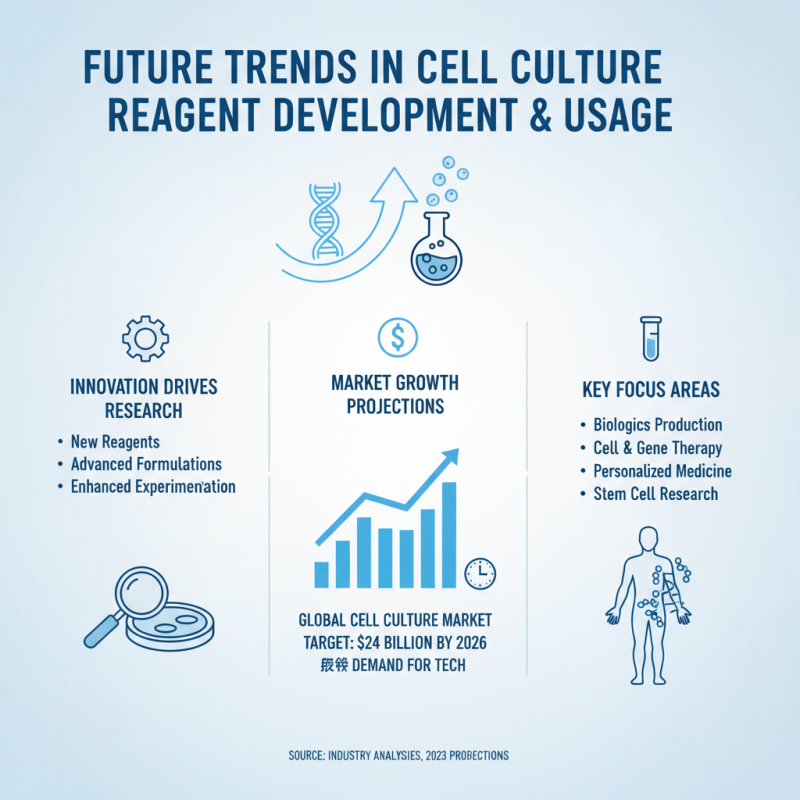
The future of cell culture reagent development is bright. Innovations are reshaping how researchers approach experiments. According to recent industry analyses, the global cell culture market is projected to reach $24 billion by 2026. This growth reflects the rising demand for advanced cell culture technologies.

One exciting trend is the development of serum-free media and vegan alternatives. These solutions cater to researchers focusing on sustainability. As of 2023, around 30% of cell culture products are derived from plant-based sources. This reflects a significant shift toward more ethical choices in research.

Tips: Experiment with new formulations to discover what's best for your cell lines. Monitor the growth dynamics closely.

Another notable advancement is automation in cell culture. Automated systems increase efficiency and reduce human error. The automation market is estimated to grow by over 15% annually. However, researchers must remain cautious. Automation might not suit every project. Always evaluate whether it meets your specific needs.

Tips: Consider maintaining manual processes for complex cultures. Sometimes, a personal touch is better.

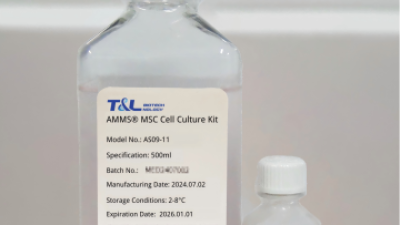
Harnessing the Power of AMMS® MSC Cell Culture Kit 2.0: Analyzing Market Trends and Scientific Advancements in Stem Cell Research

The development of advanced stem cell research methodologies has been significantly enhanced by innovations such as AMMS® MSC Cell Culture Kit 2.0. This kit has become a vital tool for scientists aiming to cultivate mesenchymal stem cells (MSCs) with high efficiency and reproducibility. Recent market trends indicate a growing demand for such advanced cell culture solutions, driven by their potential applications in regenerative medicine, tissue engineering, and various therapeutic strategies.

As the field of stem cell research evolves, the emphasis on standardized and reliable cell culture techniques becomes paramount. The AMMS® MSC Cell Culture Kit 2.0 not only provides a robust framework for MSC cultivation but also integrates cutting-edge scientific advancements. This positions researchers to explore novel avenues in cell behavior, differentiation, and functional efficacy, accelerating the pace of discoveries in stem cell biology. With the MSC cell culture kit readily available for purchase, researchers can access these advanced tools to support their pioneering studies and address critical challenges within the field.

The increasing integration of such specialized products in laboratories highlights their significance in pushing the boundaries of scientific inquiry. As techniques and methodologies continue to progress, it is crucial for researchers to stay informed about the latest market offerings that facilitate their work and enhance experimental outcomes. The AMMS® MSC Cell Culture Kit 2.0 stands out as a key asset in this landscape, reflecting the intersection of market needs and scientific innovation in stem cell research.

FAQS

: What are cell culture reagents?

: Cell culture reagents provide the environment for cell growth. They include nutrients, hormones, and growth factors.

Why is it important to choose the right reagents?

The right reagents influence cell behavior. Poor choices can lead to inconsistent experimental results.

How can researchers stay updated on reagent developments?

Researchers should monitor advancements and evaluate new reagents. Not every new product is suitable for all applications.

What challenges do researchers face with media selection?

Selecting the right medium requires understanding cell needs. Many options are available, and it can be overwhelming.

How important is quality control in reagent selection?

Quality control is crucial. Over 30% of discrepancies are due to low-quality reagents, affecting outcomes significantly.

What should researchers consider about reagent sources?

Verify the origin of reagents. Reliable providers enhance consistency; overlooking this can impact research.

How can researchers ensure reagent reliability?

Proper characterization and rigorous testing of each batch enhance reliability. Regular checks can prevent inconsistencies.

What are serum-free options in cell culture?

Serum-free solutions offer better control over growth factors. They allow customized nutrient support for specific cell lines.

Why is balancing cost and effectiveness important?

Cost can influence reagent choices. Yet, prioritizing effectiveness can prevent long-term productivity losses.

What should researchers reflect on when choosing reagents?

Reflect on the origins and quality of reagents. Tough questions can lead to better research outcomes.

Conclusion

Cell Culture Reagents play a crucial role in the success of scientific research, serving as foundational tools for cell growth and experimentation. This article provides an overview of the various categories of cell culture reagents, highlighting their importance in enhancing research outcomes. It discusses the top trending cell culture media for 2026, innovative supplements that optimize cell viability, and essential tools needed for reliable experimentation.

Additionally, the article emphasizes the significance of quality control measures in selecting effective reagents, ensuring that researchers can rely on their materials for consistent results. Looking ahead, it also explores future trends in the development and usage of cell culture reagents, indicating a dynamic and evolving landscape that researchers must navigate to achieve their scientific goals.

Lila

Lila

Lila is a dedicated marketing professional at T&L Biotechnology Co., Ltd., a company that specializes in the research and development of upstream GMP-grade raw materials and reagents for cell and gene therapy (CGT). With her extensive knowledge of CGT products, Lila plays a pivotal role in......
Previous 10 Reasons to Choose GmpGrade Materials for Your Supply Chain