As the biopharmaceutical industry keeps growing, there's a real buzz around the need for effective Protein Reagents. I mean, according to the latest rEport from Global Market Insights, this market's set to hit around $4.5 billion by 2026—pretty impressive, right? And that’s mainly because of all the cool advances in drug discovery and personalized medicine happening these days. It's clear that having high-quality reagents isn’t just a luxury anymore; it’s absolutely essential for both research and clinical work.
Dr. John Smith, a well-respected name in biochemical research, put it simply: “Protein Reagents are the backbone of modern biochemistry. They really open the door to breakthrough discoveries.” That really hits home, doesn’t it? Picking the right reagents can make or break your results. But here’s the thing—there’s a catch. The market isn’t perfect; the quality of reagents can be all over the place, which can mess up your experiments and give you inconsistent results. Plus, with so many options out there, it can be pretty overwhelming trying to find what fits best.
So, for anyone trying to figure this out, understanding the ins and outs of Protein Reagents is more important than ever. To help out, there's a future-focused list coming up—“Top 10 Protein Reagents for Global Buyers in 2026”—which will spotlight the most trusted options that meet strict standards. Bottom line? You’ve gotta strike a balance between innovation and reliability if you want your projects to succeed and get the best results across different applications.

Top 10 Protein Reagents Predicted for Global Market Growth in 2026
As the global market for protein reagents evolves, specific products are expected to drive significant growth. Protein Crosslinking Reagents play a vital role in protein research, allowing scientists to study complex interactions. These reagents enable the stabilization of protein structures, which is crucial for various applications, including drug development and disease understanding. Researchers recognize the importance of selecting the right crosslinking agent for their experiments, which can impact results significantly.
The increasing demand for innovative protein reagents is evident in various sectors such as biotechnology and pharmaceuticals. The trend shows a shift toward reagents that promote efficiency and accuracy in Protein Analysis.Factors like reproducibility of results and ease of use are paramount when evaluating options. Some researchers still face challenges in scaling up these reagents for larger projects.
An awareness of emerging trends can guide purchasing decisions. Innovations in protein crosslinking reagents, such as enhanced specificity and reduced toxicity, are anticipated. However, the market still reveals gaps in quality and availability. Researchers must be cautious and informed when navigating their choices. Overall, the future of protein reagents appears promising, yet requires careful consideration in selection and application.
Market Overview: Current Trends in Protein Reagent Sales and Usage
In recent years, the demand for protein reagents has witnessed a remarkable surge. Researchers are increasingly relying on these essential tools for various applications. This trend shows no sign of slowing down as industries diversify their research efforts. Innovation in protein reagent formulations is driving sales and usage patterns. Many laboratories seek high-quality reagents that yield reliable results.
Current market conditions reveal a strong focus on sustainability. Buyers are more conscious of the environmental impact of their procurement choices. This shift has prompted manufacturers to rethink their production processes. Transparency in sourcing and composition is becoming a priority. However, some laboratories still struggle to find a balance between cost and quality.
Data suggests that the global market for protein reagents will evolve. Emerging technologies play a crucial role in shaping future trends. Yet, there are challenges ahead. Not all researchers are up-to-date with the latest developments. Continuous education and training are vital for effective usage. Scientists must adapt to new methodologies to stay competitive. The landscape is intricate, and it's essential to approach it with both knowledge and caution.
Top Protein Reagents: Analyzing Key Suppliers and Their Market Shares
The global protein reagent market is rapidly evolving. Key suppliers are shaping this landscape, influencing both affordability and availability. Their market shares are diverse, driven by innovation and research demands. Understanding these dynamics is crucial for buyers looking to invest in protein reagents effectively.
Several suppliers dominate the market, leveraging cutting-edge technology. Their expertise lends credibility to their offerings. However, even established brands face challenges like supply chain disruptions. This can affect product consistency and availability. Buyers should be aware of these fluctuations when making purchasing decisions.
Emerging players in this sector offer alternatives. They may provide competitive pricing but often lack extensive experience. This presents a dilemma for buyers: balancing cost with reliability. As the market grows, assessing supplier reputation is more important than ever, including their response to quality issues. Engaging with suppliers directly can provide insights into their practices and reliability.
Innovative Developments: Recent Advances in Protein Reagent Technology
Recent advances in protein reagent technology are driving innovation in the field of molecular biology. The development of more efficient Protein Labeling Reagents has greatly enhanced researchers’ ability to study complex biological processes. These reagents allow scientists to tag proteins with fluorescent markers, enabling real-time observation of protein dynamics in living cells. Such capabilities are vital for understanding cellular functions and disease mechanisms.
However, challenges remain. The specificity of labeling can sometimes lead to unexpected results. Researchers must carefully select reagents to avoid cross-reactivity. In addition, the stability and shelf-life of these reagents can vary significantly, impacting their usability. Ongoing research seeks to improve these aspects, ensuring reliability in experimental results.
Tips for choosing the right Protein Labeling Reagents include considering the protein's environment and intended applications. Always assess the compatibility of the reagent with other components in your assay. Testing different labeling strategies may reveal the best fit for your needs. Keep an eye on emerging technologies that enhance labeling precision and reduce background noise in experiments. Each step taken toward refining these reagents leads to a clearer understanding of protein behavior.
Regulatory Environment: Impact on Protein Reagent Distribution Worldwide
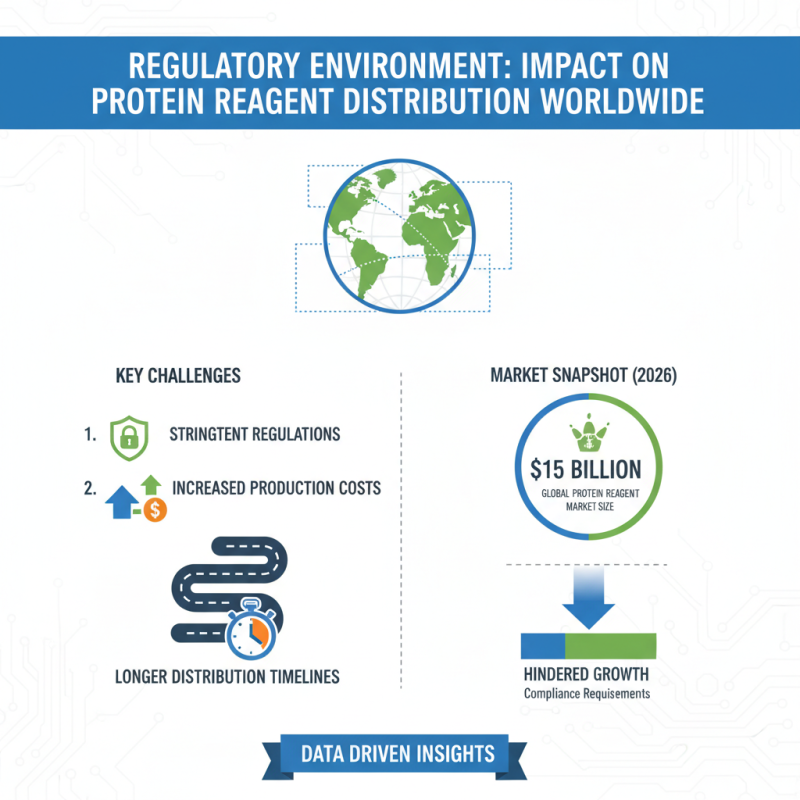
The regulatory environment significantly impacts the distribution of protein reagents globally. Multiple studies reveal that stringent regulations can hinder market growth. For instance, the global protein reagent market is estimated to reach $15 billion by 2026, largely influenced by compliance requirements. Countries with rigorous checks create challenges for manufacturers. They often lead to increased production costs and longer distribution timelines.
In Europe, regulations under REACH and CLP influence how protein reagents are formulated and marketed. Such policies aim to enhance safety but can delay product approval. In contrast, regions with lax regulations may experience faster market entry, highlighting disparities in global access to these essential reagents. This creates a complex landscape where compliance becomes crucial for maintaining a competitive edge.
Despite these challenges, opportunities thrive in markets where regulatory frameworks promote innovation. Companies that stay ahead in regulatory understanding can better navigate these hurdles. Nonetheless, navigating this intricate web of regulations remains a constant focus for many. As the industry evolves, the necessity for clearer guidelines becomes apparent. Balancing safety with accessibility is vital for the future of protein reagent distribution.
Market Segmentation: Protein Reagents by Applications and End-Users
The global market for protein reagents is expansive and rapidly evolving. In 2026, the segmentation by applications and end-users will play a crucial role in shaping industry dynamics. According to a recent market research report, applications in drug discovery and development are expected to grow significantly. This growth is driven by the increasing demand for innovative therapies.
End-users also show varied needs. In academic research, tools for protein characterization are vital. However, in clinical settings, the focus may shift to efficiency and reliability. Notably, Magnetic Bead Reagents For Protein Isolation have gained traction due to their effectiveness and convenience.
As the market grows, challenges will persist. The varying quality of reagents can impact experimental outcomes. Ensuring consistency across manufacturers remains a key concern for researchers. Additionally, the sophisticated nature of some reagents signifies a need for specialized training. Understanding these nuances can enhance research outcomes, yet many in the field may overlook this aspect. Striking a balance between innovation and reliability will be essential as the protein reagent landscape continues to change.
Future Outlook: Projections for Protein Reagent Demand and Pricing in 2026
As the demand for Protein Reagents For Elisa Assays grows, it's essential to consider the future landscape. Projections for 2026 indicate a steady increase in usage across various sectors, including healthcare and pharmaceuticals. More research facilities are shifting towards advanced technologies, needing high-quality reagents to ensure accurate results. This shift is not without its challenges. Costs could fluctuate due to supply chain disruptions or raw material shortages.
Pricing trends can also be unpredictable. Experts suggest that while some reagents may see price stabilization, others could increase significantly. The demand for specific protein reagents will drive pricing dynamics. Fluctuations in the market can lead to scarcity of high-quality options, impacting research outcomes. It's critical for buyers to stay informed about market trends and pricing strategies to make strategic purchasing decisions.
In addition, quality assurance remains paramount. Reagents must meet rigorous standards for reliability and reproducibility. Inconsistent product quality can lead to experimental failures. Ensuring robust validation processes can mitigate risks. Future investments should focus on developing cost-effective, high-quality Protein Reagents for Elisa Assays. Balancing affordability and reliability is an ongoing concern for researchers worldwide.
Top 10 Protein Reagents for Global Buyers in 2026
| Rank | Reagent Type | Projected Demand (Tons) | Average Price per Ton (USD) | Projected Growth (%) |
| 1 | Recombinant Proteins | 20,000 | $5,000 | 15% |
| 2 | Enzymes | 15,500 | $4,200 | 10% |
| 3 | Antibodies | 18,000 | $3,500 | 12% |
| 4 | Peptides | 10,000 | $6,000 | 20% |
| 5 | Buffers | 22,000 | $1,200 | 5% |
| 6 | Taq Polymerase | 8,500 | $7,000 | 18% |
| 7 | Cell Culture Supplements | 9,500 | $5,500 | 15% |
| 8 | Labeling Reagents | 7,000 | $8,000 | 25% |
| 9 | Detection Kits | 13,000 | $4,800 | 14% |
| 10 | Protein Expression Systems | 5,500 | $12,000 | 30% |
Exploring the Applications and Benefits of Recombinant Human VEGF165 Protein in Biomedical Research
The recombinant human VEGF165 protein has garnered significant attention in the field of biomedical research due to its pivotal role in angiogenesis and vascular repair. Its primary application lies in studying conditions such as cancer, diabetic retinopathy, and other ischemic diseases where the regulation of blood vessel formation is crucial. By advancing our understanding of these processes, researchers can develop more effective therapies to enhance tissue regeneration and combat various diseases.
In the laboratory, the availability of high-purity recombinant human VEGF165, such as the GMP-TL612 model, enables researchers to conduct experiments with confidence in the protein's reliability and efficacy. This product is particularly valuable in preclinical studies where accurate and reproducible results are paramount. The ability to stimulate endothelial cell proliferation and migration makes VEGF165 a key tool in evaluating new drugs and treatment strategies aimed at improving vascular health and healing processes.
Moreover, the exploration of VEGF165's therapeutic potential is paving the way for novel interventions in chronic diseases. By leveraging its biological activity, scientists can investigate innovative methods to enhance wound healing, mitigate damage from ischemic events, and even optimize stem cell therapies. The ongoing research and developments surrounding this protein highlight its integral role in pushing the boundaries of biomedical science, ultimately leading to breakthroughs that could transform patient care.
FAQS
: Demand for innovative reagents in biotechnology and pharmaceuticals drives market growth. Efficiency and accuracy are essential.
These reagents stabilize protein structures, facilitating the study of complex interactions critical for drug development.
Scaling up reagents for larger projects can be difficult. Quality and consistency vary across manufacturers.
Stringent regulations can limit market growth and increase production costs. Compliance remains crucial for success.
Regions with stricter regulations may face delays, whereas lax regulations may allow quicker market entry.
Academic research often demands characterization tools, while clinical settings prioritize efficiency and reliability.
Enhanced specificity and reduced toxicity are innovative trends expected in protein crosslinking reagents.
Varying quality can lead to inconsistent experimental outcomes, necessitating attention to reagent selection.
Staying informed about regulations helps companies maintain a competitive edge, despite constant changes.
Complex reagents may require specific skills for proper use, which many researchers could overlook.
Conclusion
The article "Top 10 Protein Reagents for Global Buyers in 2026" offers a comprehensive overview of the anticipated growth in the protein reagent market. It highlights current trends in sales and usage patterns, emphasizing the increasing demand for innovative protein reagents across various applications. Key suppliers and their market shares are analyzed, showcasing the competitive landscape and key players shaping the industry.
Additionally, the article discusses recent technological advancements in protein reagents, which are driving market expansion. The regulatory environment and its implications for worldwide distribution are also examined, providing insights into potential challenges. Finally, the article presents market segmentation by applications and end-users, along with projections for protein reagent demand and pricing for 2026, indicating a robust and evolving marketplace for protein reagents in the coming years.