Leave Your Message
0%

In the world of scientific research, Protein Reagents are pretty much essential tools. They help out with crucial experiments in biochemistry and molecular biology. I remember Dr. Sarah Thompson, a real expert in Protein Analysis, once saying, ‘Choosing the right Protein Reagents can make all the difference in your data.’ That really shows just how important they are in the lab.

Figuring out which Protein Reagents are the best isn't always a walk in the park, though. Researchers often struggle to find options that fit their specific needs, and that can lead to inconsistent results. Plus, not all Protein Reagents are equal—some work better than others—but honestly, making that choice isn’t always clear-cut.

As we look into the top 10 Protein Reagents for research, it’s really important to think about how reliable and effective they are. Usually, it’s through experience and careful evaluation that we figure out what works best. Researchers often reflect on their previous choices, too. With so many vendors out there, keeping transparency and quality in mind should be a priority when making a pick. Knowing the ins and outs of Protein Reagents can actually help push science forward and spark new innovations.

Top 10 Protein Reagents for Your Research Needs?

Essential Characteristics of High-Quality Protein Reagents

When selecting protein reagents, quality is paramount. High-quality reagents should meet stringent criteria. They must provide consistent results and exhibit high specificity. Purity levels are also critical. Impurities can lead to unreliable data and misinterpretations in experiments. Researchers often face challenges in finding agents that truly deliver on these fronts.

Reagents should be stable and easy to handle. A reagent that degrades quickly can derail an entire project. Proper storage conditions are essential, yet often overlooked. Some reagents may require cold storage, while others last longer at room temperature. The ease of use is another factor to consider. Complicated protocols can waste precious time and resources.

The source of the protein reagent matters as well. Not all suppliers have the same quality control measures. Researchers must remain vigilant when evaluating their choices. Sometimes, a reagent that seems perfect may have hidden flaws. Testing small batches can reveal inconsistencies that are not immediately apparent. A thoughtful approach is key to ensuring success in research.

Common Applications of Protein Reagents in Research

Top 10 Protein Reagents for Your Research Needs?

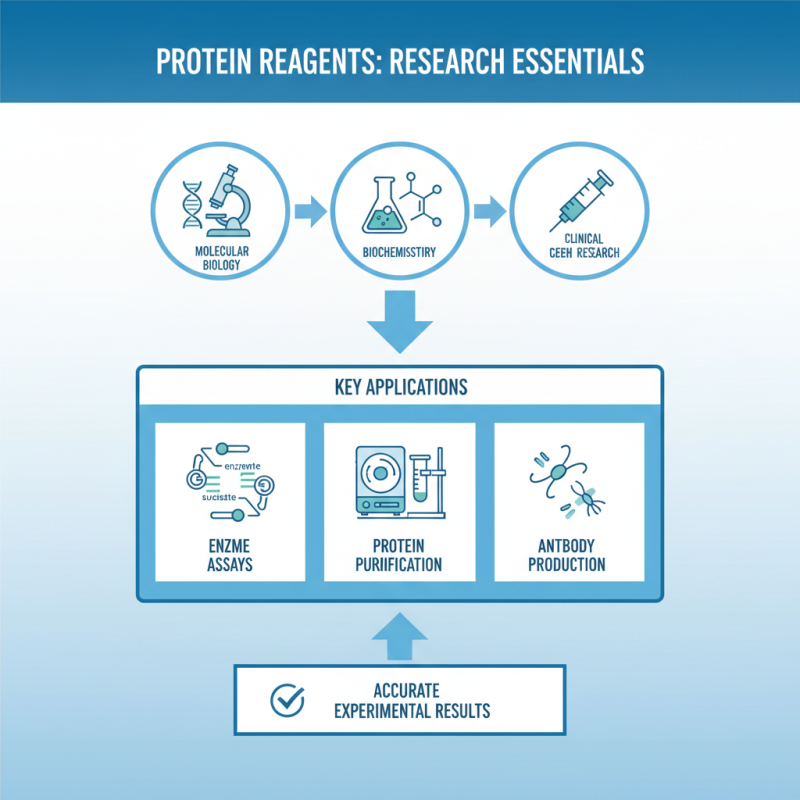
Protein reagents are vital tools in many research disciplines. They play a significant role in molecular biology, biochemistry, and clinical research. Common applications include enzyme assays, protein purification, and antibody production. Researchers often rely on these reagents for accurate experimental results.

Tip: Always check for storage conditions. Improper storage can lead to degraded Proteins, affecting your results. This is often overlooked during experiments.

Protein purification is essential for studying enzyme activity. It requires careful handling of reagents to maintain protein integrity. Researchers sometimes face challenges in achieving desired purity levels. This can lead to unexpected results and wasted resources.

Tip: Consider running pilot experiments. This helps in optimizing protocols before full-scale experiments. Understanding the nature of your protein can lead to better outcomes. Effective troubleshooting is critical for refining your technique.

Top Protein Reagents for Enzyme-Linked Assays

When it comes to enzyme-linked assays, choosing the right protein reagents is crucial. These reagents play a significant role in ensuring the accuracy and reliability of your experiments. Selecting high-quality proteins can enhance sensitivity and reduce background noise in results.

One key tip is to validate the source of your proteins. Not all proteins are created equal, and variations can lead to inconsistent results. Always check specifications, and consider testing multiple sources. This step is often overlooked, but it can save time and resources in the long run.

Another important aspect is to maintain optimal storage conditions. Improper storage can degrade proteins, affecting their functionality. Make sure to store reagents as recommended, and keep track of expiration dates. Regularly reviewing inventory may seem tedious, but it prevents potential issues during critical experiments.

Choosing the Right Protein Reagent for Your Experiments

Choosing the right protein reagent is crucial for successful experiments. Protein reagents can influence the accuracy and reproducibility of results. A study published in the *Journal of Proteomics* noted that around 30% of experimental failure could be traced back to reagent selection. This highlights the need for careful consideration.

When selecting a protein reagent, it’s essential to evaluate factors like purity and consistency. High purity reagents provide better specificity. However, even highly pure reagents may exhibit batch-to-batch variations. A report from the *Nature Methods* indicates that more than 40% of researchers experienced inconsistent results due to different reagent batches. This raises questions about reliability.

Understanding your specific research goals is equally important. Certain experiments require specific binding affinities or structures. Not all reagents perform equally across different assays. A recent survey revealed that nearly 25% of researchers felt overwhelmed by the choices available. They often wished for clearer guidelines. This suggests a gap that needs addressing in the scientific community.

Top 10 Protein Reagents for Your Research Needs

This bar chart illustrates the use of various protein reagents in research experiments, highlighting their popularity based on citations in scientific literature.

Cost-Effectiveness of Popular Protein Reagents

When selecting protein reagents for research, cost-effectiveness is crucial. Many researchers face tight budgets. A thoughtful selection can optimize funds and enhance project outcomes. Some protein reagents are affordable yet perform remarkably well. Others are expensive, but they might not always justify their price.

Consider the variety of protein assays available. Some assays deliver reliable results at a fraction of the cost. For instance, one reagent may effectively quantify proteins but costs significantly less than its competitors. This choice can impact financial constraints while maintaining quality.

However, relying solely on cost can lead to compromise. Low-cost options might lack robustness or yield inconsistent results. Researchers must balance price with performance. Investing time in thorough evaluations of each reagent is necessary. Sometimes, the cheapest option can end up costing more in the long run due to wasted time and resources. A clear understanding of the specific project needs will guide better choices.

Factors Influencing the Selection of Protein Reagents

Selecting protein reagents for research can be a complex process. Several factors influence this choice, including the intended application, target protein characteristics, and the reproducibility of results. The application determines if you need antibodies, enzymes, or tags. Each category of reagents has unique properties that cater to specific experimental requirements.

The characteristics of the target protein greatly influence reagent selection. Factors like stability, expression levels, and post-translational modifications play crucial roles. Sometimes, researchers may overlook these aspects. This can lead to suboptimal results or failed experiments. The reproducibility of results is another significant aspect. It is essential to choose reagents from reliable sources to ensure that future experiments yield consistent data. However, this can be challenging. Not all suppliers maintain the same quality standards over time.

Moreover, budget constraints can limit choices. High-quality reagents may be more expensive, but they often provide better outcomes. Balancing cost and quality is a constant struggle. Researchers must reflect on their priorities. Are they willing to invest more for assured quality? The decision-making process involves careful consideration of all these factors, always keeping in mind the ultimate research goals.

Future Trends in Protein Reagent Development and Use

The landscape of protein reagent development is rapidly evolving. Researchers are increasingly focusing on innovative techniques to enhance protein analysis and characterization. A recent industry report highlights that the global protein reagents market is expected to grow at a CAGR of 8.9% from 2021 to 2028. This growth is largely driven by advancements in biotechnology and the rising demand for precise diagnostic tools.

Future trends suggest a shift towards customization in protein reagents. These reagents need to cater to specific research requirements. Flexible options allow for tailored experiments, enhancing reproducibility and accuracy. However, this demand poses challenges. Custom reagents often come with unpredictable lead times and quality control issues that researchers must navigate.

In addition, the integration of artificial intelligence is becoming more prevalent. AI can expedite the design and optimization of protein reagents. It's a promising development, but it also raises concerns about data security and ethical implications. Balancing innovation with responsibility will be essential as we move forward in this dynamic field.

FAQS

: What is the main purpose of the content?

: The content aims to provide useful information on the topic.

Who can benefit from this information?

Anyone interested in the topic can find it helpful.

How is the information organized?

The information is structured in clear sections for easy navigation.

Are there any specific guidelines to follow?

Yes, it is crucial to follow suggested practices.

What should I do if I have questions?

You can reach out for clarification anytime.

Is there a risk of misunderstanding the information?

Yes, some details may be complex and require careful reading.

Can I share this information with others?

Yes, sharing is encouraged for wider understanding.

How can I apply this information in real life?

Look for practical examples to implement the concepts.

What if I find inaccuracies in the content?

It is important to report those for correction.

How often is the content updated?

The content is updated periodically to stay relevant.

Conclusion

In the pursuit of advancing research, selecting the right protein reagents is crucial. High-quality protein reagents possess essential characteristics such as purity, reliability, and specific activity, which directly influence experimental outcomes. Their common applications span various fields, including enzyme-linked assays, where they facilitate precise measurements of biomolecular interactions.

When choosing protein reagents for experiments, factors such as cost-effectiveness, experimental design, and the specific needs of the research must be carefully considered. As the demand for innovative research techniques grows, future trends in protein reagent development are expected to focus on enhanced performance, sustainability, and versatility, ensuring they remain integral to scientific discoveries.


Ethan

Ethan

Ethan is a dedicated marketing professional at T&L Biotechnology Co., Ltd., where he leverages his extensive knowledge to spearhead the promotion of cutting-edge upstream GMP-grade raw materials and reagents designed for cell and gene therapy (CGT). With a strong foundation in biotechnology, Ethan......
Previous 10 Reasons to Choose GmpGrade Materials for Your Supply Chain