




China Suppliers Recombinant Human HGF Protein - GMP-TL765 from Trusted Factory, In Stock Now!
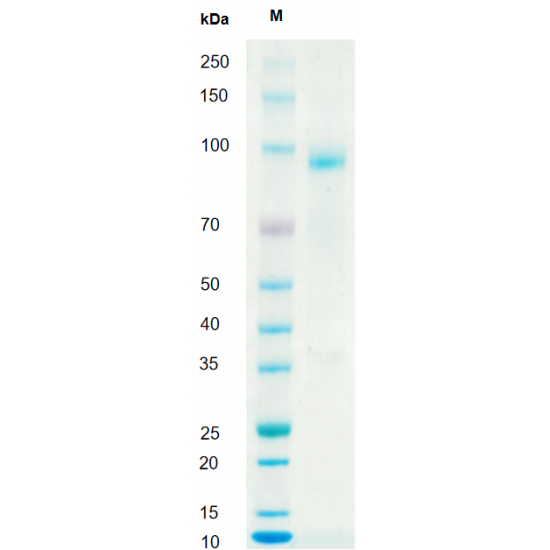
HGF is a hetrodimer molecule composed of 69-kD alpha-subunit and 34-beta-subunit. HGF is a potent mitogen for mature parenchymal hepatocyte cells, seems to be a hepatotrophic factor, and acts as a growth factor for a broad spectrum of tissues and cell types.
Receptor Interaction
Activating ligand for the receptor tyrosine kinase MET by binding to it and promoting its dimerization.
Organ Regeneration
HGF mRNA and HGF activity increase markedly in the liver of rats after various liver injuries such as hepatitis, ischemia, physical crush, and partial hepatectomy. Production of HGF in the liver occurs in Kupffer cells and sinusoidal endothelial cells, but not in parenchymal hepatocytes.
HGF mRNA is also markedly increased even in the intact lung, kidney, and spleen after injuries of the liver. Therefore, HGF may act as a trigger for liver regeneration through two mechanisms: a paracrine mechanism and an endocrine mechanism.
Renotropic & Epithelial Roles
HGF mRNA increases markedly in the kidney after various renal injuries, suggesting that HGF may act not only as a hepatotropic factor but also as a renotropic factor. It stimulates growth of various epithelial cells, including renal tubular cells.
It strongly enhances motility of epithelial cells and induces epithelial tubule formation, while it strongly inhibits growth of several tumor cells.
All these findings indicate that HGF may have important roles in organogenesis, morphogenesis, carcinogenesis, as well as in organ regeneration.
Frequently Asked Questions
Q1. What is the molecular structure of HGF?
HGF is a heterodimer molecule composed of a 69-kD alpha-subunit and a 34-beta-subunit.
Q2. How does HGF interact with its receptor?
HGF acts as an activating ligand for the receptor tyrosine kinase MET by binding to it and promoting its dimerization.
Q3. Where in the liver is HGF produced?
The production of HGF in the liver occurs in Kupffer cells and sinusoidal endothelial cells, but not in parenchymal hepatocytes.
Q4. Through what mechanisms does HGF trigger liver regeneration?
HGF may act as a trigger for liver regeneration through two mechanisms: a paracrine mechanism and an endocrine mechanism.
Q5. What are the roles of HGF as a Mitogen, Motogen, and Morphogen?
HGF acts as a Mitogen by stimulating the growth of various epithelial cells (including renal tubular cells), a Motogen by strongly enhancing epithelial cell motility, and a Morphogen by inducing epithelial tubule formation.
Q6. What general physiological and pathological processes involve HGF?
HGF plays important roles in organogenesis, morphogenesis, carcinogenesis, as well as in organ regeneration.